SunriseHues
“Since therefore the knowledge and survey of vice is in this world so necessary to the constituting of human virtue, and the scanning of error to the confirmation of truth, how can we more safely, and with less danger, scout into the regions of sin and falsity than by reading all manner of tractates and hearing all manner of reason? And this is the benefit which may be had of books promiscuously read.” -- John Milton, Areopagitica (1644)

The Last of the Mohicans
 I decided to pick up this "classic" after I finished reading William Cooper's Town: Power and Persuasion on the Frontier of the Early American Republic -- an excellent history of the Cooper family.
William Cooper (James Fenimore Cooper's father) was one of those rogues who, after many New York State Loyalists fled to Canada or England after the American Revolutionary War, took advantage of the ensuing chaos to make claims (often of dubious legal standing) on their "abandoned" property.

From his start as a barely-literate wheelwright, the elder Cooper became one of the era's prominent land speculators -- and, by the standards of the time, enormously rich. And Cooperstown, NY, was the eponymous capital of his primary holding through the Otsego Patent. There the elder Cooper built a mansion and ran for political office, and also tried to re-fashion himself as an aristocrat. After he died, his children continued to live the high life for another few years. Soon his entire estate was bankrupt and auctioned off to pay creditors. James Fenimore Cooper was protected from abject poverty because he had married Susan Augusta DeLancey, the daughter of a wealthy family in Westchester County, NY.
Then James Fenimore Cooper got the idea to write a novel set in Revolutionary-era New York State. The Pioneers (1823) functioned as a retelling of his father's life story -- only with an ending more to James Fenimore's liking than what had happened in real life.
Three years later, James Fenimore Cooper published the second Leatherstocking Tale, The Last of the Mohicans. In this historical romance, Natty Bumppo aligns himself with his loyal Mohican friends Chingachgook and Uncas and works as a scout in the British army during the French and Indian War.
Afterwards, the Cooper family moved to Europe and lived in France, Switzerland, Belgium, and England for the next 7 years from 1826 to 1833. Cooper announced his retirement from writing fiction after his return to the U.S. in 1833, but had to resume writing in 1838 due to financial strain.
Ian Watt, in his famous The Rise of the Novel, correlates the 18th-century burgeoning of novelistic production with the growing demand for at-home entertainment by women who had been liberated from traditional household tasks and had too much time on their hands. In a straightforward way, the novel rose in England in the 18th century from the ashes of boredom. Amid dramatic social changes caused by the Industrial Revolution arose a romanticism for earlier times, when lives were "as they should be", and an equal but opposite romanticism about the brave or lucky individuals who transcended their expected fates, such as Henry Fielding's Tom Jones. This extended into the early 19th century, when social changes intensified and Romanticism reached its peak in the approximate period from 1800 to 1850. The Last of the Mohicans was written during the peak Romantic period.
I feel Cooper wrote this novel for that particular audience and purpose -- to help the bored conquer boredom through a different yet continual form of boredom.
The plot of The Last of the Mohicans looks compulsively straightforward. Like typical American novels in the 1820s, it was published in two volumes, and in each volume the heroines are kidnapped and later rescued. Most of the story occurs in the archetypal world of (Indian) villains who abduct (white) heroines and (white) heroes who rescue them, which is reminiscent of the "captivity narratives" written by 17th-century Puritans.
The novel associates the wilderness with humans' visceral desires. Except for Hawkeye, for whom life in the woods is a different and more impervious form of virginity than of Cora or Alice. Hawkeye is a killer, but equally important is the fact that he is not a lover. Michael Mann's 1992 movie adaptation of the novel drastically revises this aspect of Hawkeye's character, but Cooper's original words leave no room for doubt.

The wilderness in this novel is a place of transformation. In the last section, especially, there is a dizzying number of metamorphoses. But the novel refuses to endorse the possibility of racial change through intermarriage, and the racial boundaries are enforced with a vengeance. Duncan reunites with Alice, and this untainted white couple is allowed to survive and marry and inherit the future through their racially unmixed offspring.
Sex and violence, according to the Hollywood cliché, is the most dependable recipe for feeding the appetite of the popular audience. The Last of the Mohicans clearly follows this formula, and perhaps even helps the reader understand why the order of the terms is never reversed -- it's always "sex and violence," but never "violence and sex."
The true story of the Mohicans is one that the U.S. is still reluctant to tell, and repressed almost completely throughout the 19th century as the pioneers moved westward across the continent. On the other hand, Americans loved the story that Cooper tells in The Last of the Mohicans. This novel was Cooper's most popular book and one of the most widely read American novels ever.
Like most of Cooper's novels, especially those he wrote in the first half of his career, The Last of the Mohicans derives from the model of the historical romance that Sir Walter Scott had established in Waverley. The subtitle of Cooper's novel -- A Narrative of 1757 -- echoes Waverley's subtitle, 'Tis Sixty Years Since. Cooper warned mere novel readers that by "narrative" he means historical fact, not imaginative fancy. But The Last of the Mohicans turned out to be merely myth-making which served contemporary readers precisely by replacing history with a story about the inevitable fate of the Indians.
While some of Cooper's sentences sound patronizing, if not racist, to most modern readers, Cooper's books display more respect and admiration for Indian characters like Uncas than was the norm in his culture. In fact, Cooper's depiction of Uncas as such as noble savage opened the floodgates of criticism. Robert Montgomery Bird wrote Nick of the Woods (1837) to expressly contest Cooper's "poetical illusions" and "beautiful unrealities" by describing Indians instead as "ignorant, violent, debased, brutal." Mark Twain made the same argument in Roughing It (1872).
In the final chapter of The Last of the Mohicans, Cooper relieves white American readers from the burden of picturing a political and social future for the country that includes Indians by linking Uncas's death to the doom of his entire race. Neither of the two massacres in the book involves whites killing Indians.
Even as a fantasy, The Last of the Mohicans arises from the brute facts of American history and projects a psychological and socio-historical fantasy onto its dark savages. It could even be considered a response to America's own empire-building.
Victor Hugo once pronounced Cooper "greater than the great master of modern romance." And this verdict was echoed by Balzac and Rudolf Drescher of Germany.
Perhaps those bored housewives (many were probably James Fenimore Cooper's avid fans) passed down this historical romance through the generations and that's how it became a classic.

Economy and Society in Ancient Greece (Pelican S.)
 A collection of Finley's 14 most important essays on the social and economic conditions of antiquity -- a useful reference for academic specialists.
The essays are organized around 3 topics: the ancient polis, slavery and dependent labor, and the Mycenaean and Homeric worlds.
I particularly liked the essay comparing the Greek conception of freedom with that of John Stuart Mill and the United Nations Declaration of Human Rights.
This collection covers subjects from Athenian imperialism to Homeric marriage. Two themes stand out: the relationship of social values to economic activity, and the analysis of antiquity's stratification system.

Adam Smith and the Classics: The Classical Heritage in Adam Smith's Thought
 A fascinating read (for anyone who is seriously interested in Adam Smith and his thoughts).
This is a painstakingly-researched, meticulously-documented study on one aspect of Adam Smith's cultural heritage which has eluded many people: his formidable grounding in the classics, which did not seem exceptional at all in the 18th century but nonetheless was one of the linchpins of his economic theories.
This book was originally written for a non-specialist, Italian readership, which explains the numerous references to Italian intellectuals, and the copious summaries of Smith's texts (skip those if you are already familiar with his work), as well as certain details (e.g., on classical studies in England or the Scottish legal system).
Although Adam Smith himself and his works had been studied widely, his relationship with the classical scholars had not. Until the publication of this book, only scattered observations could be found in articles which discussed in-depth Smith's debt to the classics.
Traditional intellectual history has sarcastically been defined as "a kind of foxhunt for ideas through the centuries (which usually ended with Aristotle and Plato)," but clearly this type of search would be idle if the sole aim were to demonstrate that nothing new existed under the sun. [I]t would be rather hazardous to maintain that it is pointless to learn as much as possible about the cultural background of a man of ideas, since his thought, new and important for the development of future knowledge, does not spring from nothing, but consists, at least in part, of personal reflection on and critical elaboration of what he has received, and of the use of the logical tools from the distant and recent past.
The author goes back to Smith's years at the Glasgow College (where Smith entered at age 15 and stayed for 3 years) to examine the earliest form of Smith's predilection that would last his entire life.
Francis Hutcheson, “the never to be forgotten Dr. Hutcheson,” was the man responsible for sowing that seed. He introduced and revitalized the study of the classics at Glasgow, and Smith caught the bug there. This early classical education is present in nearly all of Smith's writings.
The classical heritage that underlies the corpus of Smith's work falls into two groups: direct influences and indirect influences.
Within direct influences are two types of reminiscence:
1) the explicit and conscious, including all the express references, quotations, recounted episodes, parallels, etc.
2) the inexplicit and unconscious, observed when Smith echoes classical phrases or passages that he has clearly read over or studied so much that they stick in his memory and re-emerge as his own expressions.
Indirect influences are more a matter of ideas, concepts, kernels, or trains of thought of classical origin which, passing through a lengthy process of transformation, adaptation, and "rediscovery" from century to century, had finally arrived, somewhat modified, in the Age of Enlightenment. In Smith's time, these ideas were common currency in learned circles, and Smith allowed himself to be influenced by these ideas only to the extent that they could broaden his mind and stimulate its capacity for independent thought. These were motives that prompted him to analyze and discuss specific problems: while he also derived the technical capacity for doing so from classical civilization, with its rational and logically appropriate division of distinct and interrelated subjects.
This study focuses on the indirect type of classical influence in Smith's work, since the author considers it to be more important.

The author concludes that the classical influence in Smith's thought appears as
[...] a composite set of elements, among which is a Stoic theoretical principle (universal harmony, which upholds the principle that the interests of the individual are not opposed to those of the community), with which Aristotelian, Epicurean, or again Stoic elements intertwined to regulate individual behavior so that harmony could be reached.
...
Smith's classical perspective was influenced (or partially distorted) not only by humanistic, Renaissance, and Baconian interpretations, but also by his own philosophical concepts (above all his concepts of sympathy). But it constituted a constant reference point for his ethical, political, and even scientific thought. His spirit was exercised and nourished by the classics, in complete freedom, and he maintained a stance with respect to these influences which is summed up in the phrase attributed by Politian to Cosimo de' Medici: "Rare talents are celestial forms, not carrier donkeys."
Smith always considered TMS to be his most authoritative work.
I reveled in this fabulous intellectual journey with the author through Adam Smith's classical world.

The Big Three in Economics: Adam Smith, Karl Marx, and John Maynard Keynes
 It appears to be that Skousen did not take his time to carefully examine Adam Smith's An Inquiry into the Nature and Causes of the Wealth of Nations, because a lot of his assertions about Adam Smith's free trade theory seem to be nothing more than a synopsis of common myths -- and those common myths are often distorted interpretations of Adam Smith's real thought on free trade.
Adam Smith's practical objective in developing the argument for free trade differed from that of the classical and neoclassical economists after him. So did his "meaning" of free trade.
The Wealth of Nations was a reformist response to a pressing issue of international economic policy in the historical context. Adam Smith wrote this book to use facts to attack the misguided mercantilist doctrines (the economic equivalent of political absolutism and dominant in Europe in the 16th-18th centuries) which, at the time, boded to reduce the sum of economic exchange between England and France to smuggling. The very same mercantilist doctrines supported a corrupt and exploitative British colonial policy -- the flaws of which were self-evident to those who started the American Revolution in the same year that Adam Smith's The Wealth of Nations was published. The book is Adam Smith's theoretical instrument to destroy the prevalent mercantilist doctrine and policy.
It seems to me that, for Adam Smith, international trade -- while certainly better "free" than in the hands of government-sponsored monopolies -- was something of a last resort for increasing the wealth of nations. Absent the artificial stimulus to foreign trade under mercantilism, the nation would be led to exploit the more productive domestic uses of capital, before investing large sums of capital in those less productive.
The author clearly portrays Karl Marx like a devil while worshiping Adam Smith like a saint.
His one-sided view reads more like a propaganda (to serve whatever cause) than an objective academic analysis on how these three great thinkers influenced the realm of economic thoughts and how their ideas are still relevant or irrelevant today.
A history of the campaigns of 1780 and 1781, in the southern provinces of North America, by Lieutenant-Colonel Tarleton. ...
Tarleton's history begins with D'Estaing's fruitless attack on Savannah, GA in the fall of 1779, and then proceeds to give a minute detail of all the military operations in both the Carolinas and part of Virginia, until the surrender of Yorktown and Gloucester on October 19, 1781, when Lord Cornwallis, with his whole army, fell into the siege of Franco-American alliance.In Tarleton's history, some facts have been withheld, and some mutilated, while others are raised to importance. If historical justice had been the Tarleton's object, those facts are by no means entitled to that level of importance. Other most notable features are prejudices and party spirits.
Once again, it reinforces the thesis statement that it is the memory which has been created for us about the war that colors our understanding of this historical period.
Nevertheless, this book is handsomely printed and enriched with some explanatory maps and plans, especially those relating to the Battle of Camden and Guildford, and the sieges of Charles Town and Yorktown.
Statue Of Liberty (Wonders Of Man)
An informative and lively history of this monument.Interesting stories of Frédéric Auguste Bartholdi, Alexandre Gustave Eiffel, and Joseph Pulitzer.
War And Society In Revolutionary America: The Wider Dimensions Of Conflict
A selection of a dozen short pieces from Higginbotham's numerous writings on the American War of Independence and related topics.
behavior of Markets - Benoit Mandelbrot;Richard L. Hudson)
The (Mis)behavior of Markets

I really can't believe how far this book falls short of what it could have been. I was expecting an in-depth theoretical exploration and practical application of fractal geometry in finance, but instead I got a popular science book written for the general reader.
This book covers the bare minimum about fractal geometry and doesn't advance beyond the superficial discussions (compared to Benoît Mandelbrot's 1982 book The Fractal Geometry of Nature), at least it seems to me.

Fractals are shapes that reproduce themselves infinitely -- each offshoot of the shape is an approximate miniature of the original shape. Every time you zoom in further, you always find exactly the same shape. It's like a romanesco cauliflower, each small part of it is exactly the same as the entire cauliflower itself. This property is called self-similarity.

The study of fractals and the math behind them can be traced back to the 17th-century mathematician Gottfried Leibniz, who contemplated the idea of recursive self-similarity. A few mathematicians after Leibniz dabbled in "fractal geometry" (the term wasn't coined until Mandelbrot). Karl Weierstrass in 1872 offered a function whose graph would be considered a fractal; Helge von Koch in 1904 refined Weierstrass's definition and came up with a function that produces the Koch curve.
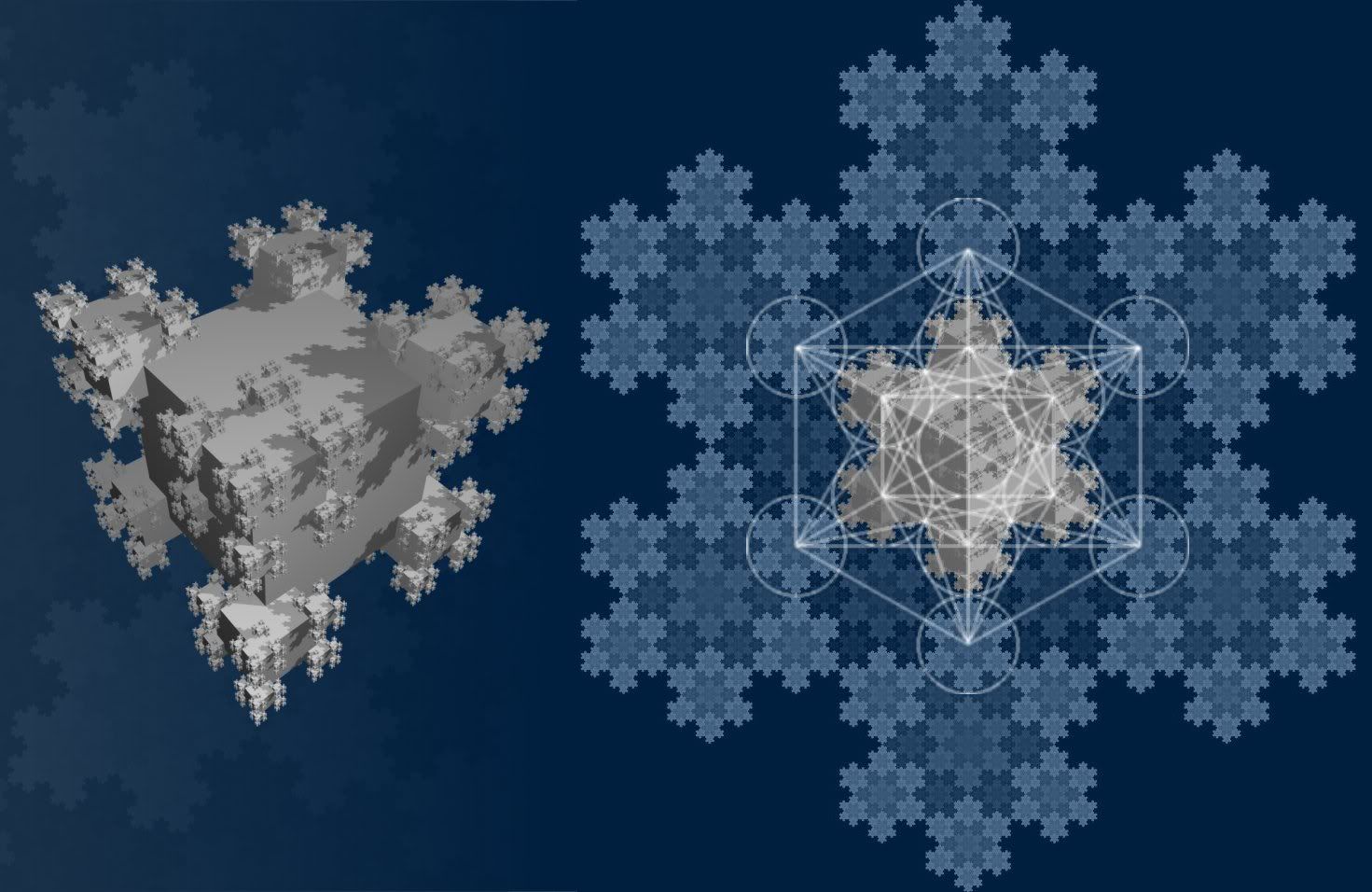
Mandelbrot didn't start studying fractals and the property of "self-similarity" until the 1960s, while he was working as a research fellow at IBM. Mandelbrot coined the word "fractal" in 1975, and used a computer to construct visualizations.
Fractals look so cool that Mandelbrot came to be known as a stand-up guy in both mathematics and pop culture.
Fractals made by 3D printing:


Perhaps I over-studied mathematics in college (my senior honors thesis was in fractal geometry and chaos theory and I spent a summer at the Institute for Advanced Study in Princeton), or maybe the "maverick mathematician" is either too arrogant or too humble to share his research with the general public, but this book tells me nothing about fractal geometry that I don't already know. I was quite disappointed.
In terms of insights into behavioral finance or market analysis, I don't think I've gained anything new from this book besides re-reading the excessively broad and clichéd conclusions, such as
► markets are turbulent;
► markets are very, very risky -- more risky than the standard theories imagine;
► market "timing" matters greatly;
► prices often leap, not glide;
► markets in all places and ages work alike;
► markets are inherently uncertain, and bubbles are inevitable;
► markets are deceptive;
► forecasting prices may be perilous, but you can estimate the odds of future volatility;
► in financial markets, the idea of "value" has limited value.
His fractal view of finance might have been revolutionary when it first came out, but I find nothing new today.
The author merely provides a generic and repetitive hindsight perspective on the wild price fluctuations in financial markets. I think the fractal patterns in financial markets and their implications for price stability might have been more effectively illustrated by a few representative charts:


Currently reading
The Ballad of a Small Player: A Novel
Progress:
91/272 pages

The Wet And The Dry: A Drinker's Journey

Echo: The Complete Edition
Blood of Tyrants

The Night Circus

Brideshead Revisited
The Professor and the Siren (New York Review Books Classics)

What Matters Most is How Well You Walk Through the Fire

The Muslims Are Coming!: Islamophobia, Extremism, and the Domestic War on Terror

The Exploits and Adventures of Brigadier Gerard


